Why Is My Dishwasher Not Draining?
Some links in our guides may earn us a commission at no extra cost to you — here's why we only recommend what we'd buy.
Jump to a section
You open the dishwasher expecting clean dishes and find a pool of murky water instead. Before you panic or call for service, know this: most dishwasher drainage problems come down to a short list of usual suspects — and most of them take under 20 minutes to check.
Safety First
Turn the dishwasher off. If you will touch anything beyond the filter — the hose, the air gap, wiring areas — switch the breaker off too. Water and electricity are a bad combination, and five seconds at the breaker box is cheap insurance.
1. A Clogged Filter (The #1 Cause)
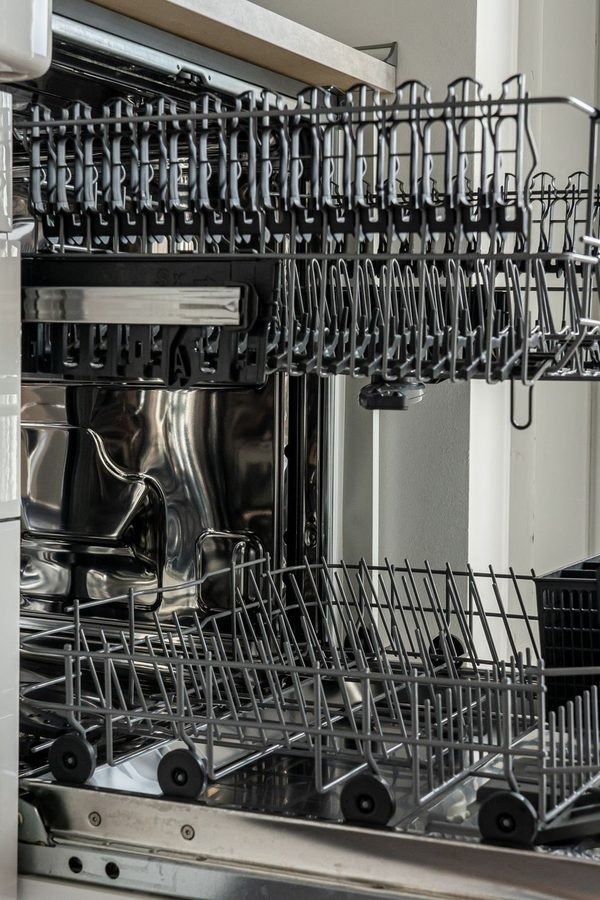
Modern dishwashers have a removable filter at the bottom that traps food particles. When it clogs, water has nowhere to go.
- Remove the bottom rack.
- Twist the cylindrical filter assembly counterclockwise and lift it out.
- Rinse it under hot water and scrub with an old toothbrush and dish soap.
- While it is out, check the sump area underneath for glass shards or chunks of food — wear gloves.
- Reinstall the filter, replace the rack, and run a short cycle to test.
Hearthly tip: if you have never cleaned this filter, start here. In our experience reading hundreds of fix-it threads, this solves the problem more often than everything else combined.
2. A Kinked or Clogged Drain Hose
The corrugated drain hose runs from the dishwasher to the sink drain or garbage disposal. A sharp kink — often from the machine being pushed back too hard — stops water cold.
- Access the hose under the sink or by pulling the dishwasher out a few inches.
- Look for sharp bends and straighten them gently.
- If the hose looks fine outside, disconnect it with a bucket and towels ready, and flush water through to check for an internal clog.
3. A Blocked Air Gap
If you have a small chrome dome on the sink next to the faucet, that is the air gap — and it clogs with debris over time.
- Pop off the chrome cap.
- Pull out any visible gunk with tweezers or a bottle brush.
- Replace the cap and run a drain cycle.
4. The Garbage Disposal Knockout Plug
Did the problem start right after a new garbage disposal was installed? The dishwasher drain hose connects to the disposal, and new disposals ship with a small plastic "knockout plug" sealing that inlet. If the installer forgot to knock it out, the dishwasher has literally never been able to drain.
Fixing it means disconnecting power, removing the hose, and tapping the plug out with a screwdriver and hammer. If that sentence made you nervous, just call the installer back — finishing the installation properly is their job.
5. Is It Actually Broken? Check What Is Normal First
A small amount of water sitting around the drain — roughly a cup or less — is normal in many models. Check your manual. If it is more than that, work through the steps above, then run the machine's drain or cancel cycle and watch what happens.
When to Call a Professional
- The filter, hose, and air gap are all clear and it still will not drain — the drain pump itself may have failed.
- You hear humming or grinding but no draining.
- Water is leaking onto the floor.
Pump replacement involves wiring and water lines — firmly pro territory for most people.
Prevent It Next Time
- Scrape plates well before loading. (No need to pre-rinse for modern machines — but scraping matters.)
- Clean the filter once a month. Set a phone reminder.
- Run hot water at the kitchen tap for 30 seconds before starting the dishwasher, so the cycle begins with hot water.
- If the dishwasher shares a drain with the disposal, run the disposal first.
Final Thoughts
Nine times out of ten, a non-draining dishwasher is a filter or a hose — both free to fix. Work through the list in order, and you will either solve it or know exactly what to tell the repair technician.