Afrohemian Decor: Pinterest’s 2026 Trend, Styled on a Budget
Some links in our guides may earn us a commission at no extra cost to you — here's why we only recommend what we'd buy.
Jump to a section
Every December, Pinterest publishes its “Pinterest Predicts” report — and its track record is strikingly good. For 2026, one of the breakout interior trends is Afrohemian: a fusion of African artistry and bohemian soul. Pinterest reports searches for “afrobohemian home decor” climbing roughly 220% year over year, with related terms like adire fabric (+130%), bamboo beaded curtains (+60%), and Ethiopian art (+50%) all surging. If you have been craving a home with more warmth, story, and soul — here is your trend, and it is wonderfully budget-friendly.
What Is Afrohemian Decor?
Afrohemian blends two rich design languages. From African craft traditions come bold geometric textiles (mudcloth from Mali, adire indigo-dyed fabric from Nigeria, kente-inspired weaves), handwoven baskets, carved wood, and earthy natural materials. From bohemian style come the layered, collected, rule-breaking spirit — plants everywhere, mixed patterns, vintage finds, and rooms that feel gathered over time rather than bought in a day.
The result is interiors that feel grounded and alive: warm neutrals and deep earth tones, tactile natural fibres, pattern with purpose, and objects that look handmade because many of them are. It is maximalism with roots — every piece carries cultural weight, which is exactly why the trend resonates right now.
A note on respect: Afrohemian draws on real craft traditions with deep meaning — mudcloth patterns, for example, traditionally tell stories. Enjoy the aesthetic, buy from African and Black artisans when you can, and skip anything that treats sacred or ceremonial objects as mere decoration. Appreciation, not costume.
The Signature Elements
- Mudcloth (bogolan) textiles: The graphic black-and-white (or rust-and-cream) geometric patterns of Malian mudcloth — on throw pillows, wall hangings, or draped over a sofa — are the quickest Afrohemian signal in any room.
- Adire indigo fabric: Nigerian indigo-dyed cloth with its deep blue patterns works as curtains, table runners, or framed textile art. Pinterest reports searches up about 130%.
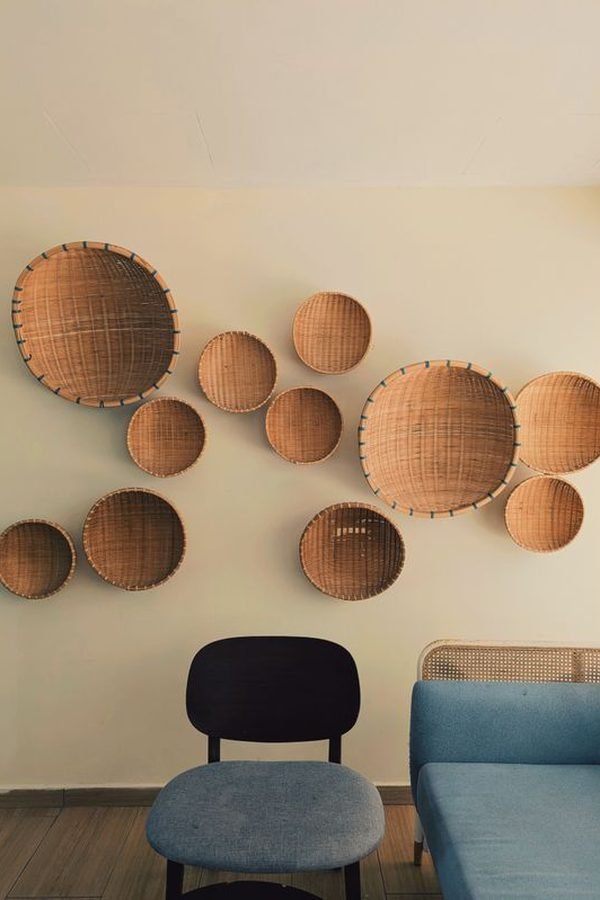
- Woven baskets as wall art: A cluster of flat woven baskets (the kind made for winnowing grain) arranged on a wall is a stunning, sculptural focal point — and often very affordable at markets and import shops.
- Rattan, bamboo, and cane: Natural woven furniture and accents — a rattan chair, bamboo beaded curtains (+60% in searches), woven pendant lights — bring the airy boho half of the equation.
- Carved wood and sculpture: One striking carved piece — a stool, a mask displayed respectfully as art, a wooden bowl — anchors the room with authenticity.
- Earthy palette: Terracotta, ochre, clay, warm black, cream, and indigo. Rich, sun-baked, grounding.
- Plants, abundantly: Large leafy plants in woven baskets complete the look and cost little.
How to Style Afrohemian on a Budget
This is one of the most budget-friendly trends in years, because its soul is handmade, vintage, and natural — not expensive. Here is how to get the look for less:
Start with textiles
Textiles are the highest-impact, lowest-cost entry point. Mudcloth-style pillow covers are widely available at reasonable prices, and a single bold throw can Afrohemian-ise an ordinary sofa in seconds. For the crafty, stencilling mudcloth-inspired geometric patterns onto plain cushion covers with fabric paint is a genuinely fun weekend project.
Go basket-first on walls
Before buying art, consider a basket wall. Woven baskets from import shops, world markets, or online marketplaces often cost a few dollars each, and a cluster of five to seven in varying sizes makes a gallery wall with more personality than framed prints at ten times the price.
Thrift the bones
Rattan chairs, wooden stools, woven pendant shades, and terracotta pots are thrift-shop staples in most cities. The patina of age actually suits this style — Afrohemian loves things that look lived-in and loved.
One authentic piece beats ten imitations
If your budget allows a single considered purchase, make it something made by hand — a genuinely handwoven basket, a textile from a fair-trade seller, a carved bowl from an artisan market. One real piece gives the whole room credibility that mass-produced “tribal print” never will.
Afrohemian Room by Room
- Living room: Neutral sofa + mudcloth pillows + basket wall + rattan chair + big plant in a woven planter. Done — that is the whole formula.
- Bedroom: Layer adire or mudcloth-patterned bedding over plain linen sheets, add a woven bench at the foot of the bed, and hang one large textile as a headboard alternative.
- Dining area: A jute or sisal rug, wooden table styled with a woven runner, and mismatched handmade-feel ceramics. Candlelight does the rest.
Common Mistakes to Avoid
- Pattern overload: Bold African textiles are powerful — give them breathing room with plenty of plain neutrals. Two or three patterned pieces per room is plenty.
- The “safari” trap: Afrohemian is about craft and artistry, not safari clichés. Skip the animal-print-everything and faux-trophy aesthetics entirely.
- Ignoring scale: A tiny mudcloth pillow gets lost on a big sectional; one large textile makes a stronger statement than five small accessories.
- Forgetting the boho half: Without the layered plants, vintage finds, and relaxed mixing, you get a showroom of African crafts rather than a lived-in Afrohemian home. Let it be a little undone.
Your Questions, Answered
What does Afrohemian mean?
It is a fusion of African design traditions (textiles like mudcloth and adire, woven baskets, carved wood, natural materials) with bohemian styling (layered, eclectic, plant-filled, collected-over-time). Pinterest coined the term in its Predicts 2026 report after spotting roughly 220% search growth for “afrobohemian home decor.”
Is Afrohemian decor expensive?
It is one of the most budget-friendly trends around. Its core materials — woven baskets, natural fibres, thrifted rattan, DIY textiles — are inherently affordable, and the style celebrates handmade and vintage over new and pricey.
How is Afrohemian different from regular boho?
Classic boho pulls from everywhere — Moroccan, Indian, Southwestern, vintage European. Afrohemian centres specifically on African craft traditions and pairs them with a deeper, earthier palette and more intentional cultural grounding.
Trends come and go, but a home layered with handmade textiles, natural materials, and objects that mean something does not really date. Whether Afrohemian is your whole style or just a beautiful accent in one room, it is a trend worth trying — especially when trying it costs so little.