Laundry Room Organization Ideas for Small Spaces
Some links in our guides may earn us a commission at no extra cost to you — here's why we only recommend what we'd buy.
Jump to a section
Laundry rooms are the smallest rooms in the house with the biggest job. Sorting, washing, drying, folding, stain-treating, and storing supplies all happen in a space that is often barely wider than the machines themselves. These laundry room organization ideas for small spaces are built around the workflow — where things happen, in what order — so even a laundry closet can run like a proper laundry room.
Design Around the Workflow, Not the Walls
Every load of laundry follows the same five steps: sort, wash, dry, fold, put away. Good small laundry rooms place each step next to the next one. Detergent and stain treatment live within arm's reach of the washer. Drying space — a rack, a rod, a line — sits near the dryer. A folding surface (even a board laid across the machines) is close enough to catch warm clothes straight out of the dryer. And a "put away" basket collects finished laundry so it actually leaves the room.
Before buying anything, watch yourself do laundry once and notice where you walk, reach, and pile things. The spots where you naturally set things down are where the storage belongs. Organizing against your own habits never lasts; organizing with them barely needs maintaining.
Go Vertical: Storage Above and Around the Machines
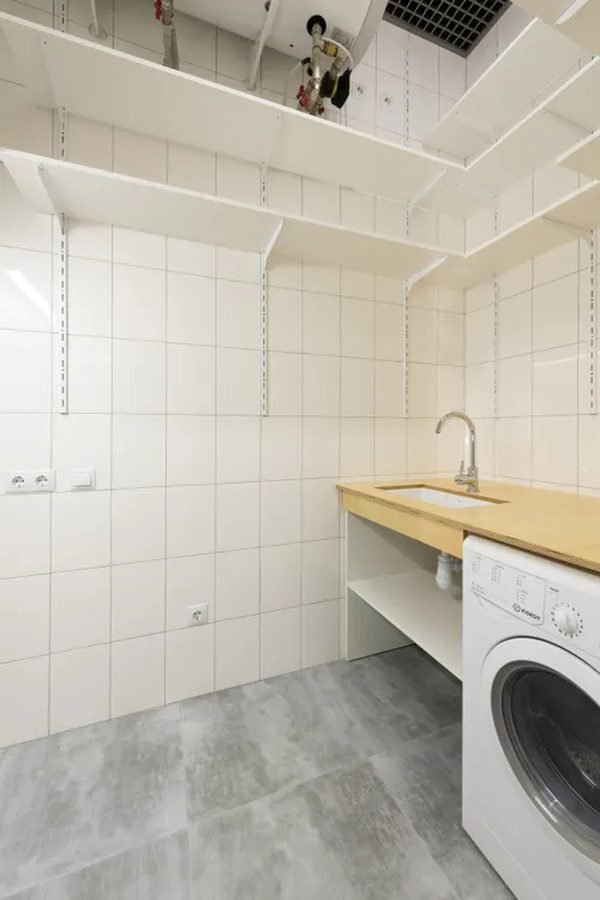
In a small laundry room, the walls are the only real estate you have. The space above the machines alone can hold nearly every supply you own:
- Wall shelves above the machines. One or two sturdy shelves hold detergent, softener, and stain treatment. Keep heavy jugs low (the shelf right above the machines) and light items higher — a falling detergent bottle is a mess and a hazard.
- A narrow rolling cart. The 15–20 cm gap beside most machines fits a slim rolling cart perfectly. It holds the small stuff — dryer sheets, mesh bags, clothespins, the lost-sock collection — and rolls out when you need it.
- Magnetic shelves on the machine sides. Washer and dryer cabinets are metal, which means magnetic spice-style shelves stick right to them. They are perfect for the small items that otherwise clutter the machine tops.
- Pegboard for tools. A small pegboard on the remaining wall holds the iron, the lint roller, scissors, and a stain-treatment caddy on hooks — all visible, all off the surfaces.
- Over-the-door rack. In a laundry closet, the inside of the door carries brooms, the ironing board, or extra supplies on a narrow rack.
One safety note: keep shelving clear of the dryer vent and never store anything flammable near it. And leave the machine tops as clear as possible — they are your folding surface, not a shelf.
Laundry Closets and Combined Setups
Many small homes do not have a laundry room at all — just a closet, a bathroom corner, or machines tucked into the kitchen. These setups need the same workflow in less space:
- Stacked units. With a stacked washer-dryer, the wall beside the stack becomes command central: a tension rod mounted at chest height for hang-drying delicates, and one shelf above the door frame for supplies.
- Machines in the bathroom or kitchen. Use a rolling cart that tucks into a gap when not in use, and a carrying caddy for detergent and tools — the caddy travels to the machine, then lives in a cabinet when laundry day is over.
- Hide it simply. A curtain on a tension rod, a folding screen, or louvered closet doors keep a working laundry corner from dominating the room visually. This is cosmetic, but it matters: a laundry setup you have to look at all day is a setup you will resent.
- Fold-down everything. In combined spaces, a wall-mounted fold-down drying rack and a fold-down ironing board give you full function that disappears when guests come over.
A Sorting System That Actually Gets Used
Sorting fails when it requires extra trips. The fix is the three-bin rule: lights, darks, and delicates/towels — in labeled bins, hampers, or even sturdy laundry bags on hooks. The critical detail is placement: the sorter lives where dirty clothes land (the bedroom or bathroom), not only at the machine. If sorting happens at the hamper, wash day starts with three ready loads instead of a mountain of mixed laundry.
Add two small upgrades and the system runs itself. First, a stain basket: a small basket near the washer holding pre-treat spray and a brush, with a house rule that stained items go there immediately, not into the general hamper. Second, mesh bags for delicates hung on a hook by the sorter — small items go straight into a bag, and the bag goes straight into the machine. No more hunting for the second sock.
Tip: label the bins with what goes inside, not just "lights" and "darks." A bin that says "Delicates — mesh bags" gets used correctly by everyone in the house, including teenagers and guests.
Drying, Folding, and Ironing in Tiny Spaces
Drying is where small laundry rooms struggle most, because air-drying takes space by definition. These options take almost none:
- A retractable wall-mounted clothesline. It extends across the room when needed and vanishes into a small housing when not. Under $20 and the best drying-per-square-foot option available.
- A fold-down wall drying rack. More capacity than a line, still flat against the wall when folded. Ideal for sweaters that should not hang.
- An over-the-door hanging rack. For delicates and the "hang dry" tags that pile up — a few hangers on a door-mounted hook rail handle a full load's worth.
- A board across the machines. A simple wooden board laid across the washer and dryer (with rubber feet so it does not scratch) is a folding table exactly where folding happens.
- A door-hung ironing board. A compact board on a hook behind the door, with the iron stored on a heat-safe wall mount nearby. Full ironing capability in zero floor space.
The 5-Minute Laundry Reset
Laundry rooms drift into chaos faster than any other room because every step of the process creates a small mess. A five-minute reset after wash day keeps it under control:
- Clear the lint trap and wipe the machine tops. Thirty seconds that prevents the slow buildup of dust and detergent residue.
- Return every supply to its shelf or cart. Detergent left on the machine becomes permanent; detergent returned to the shelf stays a habit.
- Empty the "put away" basket. Finished laundry that sits in the laundry room eventually gets re-washed "just in case." Carry it out the same day.
- Check the stain basket. Treat anything waiting before the next wash day so stains do not set.
Final Thought
A small laundry room does not need more square footage — it needs the workflow laid out in order, the walls doing the storage work, and a sorting system that starts at the hamper instead of at the machine. Shelves above, a cart beside, a line that retracts, and five minutes of reset after wash day: that is the whole system, and it fits in a closet.