Pantry Organization Ideas on a Budget: A System That Stays Tidy
Some links in our guides may earn us a commission at no extra cost to you — here's why we only recommend what we'd buy.
Jump to a section
A freshly organized pantry looks great for about two weeks. Then the cereal boxes migrate, the snacks merge with the baking supplies, and something expired is hiding behind the soup cans again. The problem is rarely effort. Most pantry chaos happens because the pantry was "tidied," not "systematized." These pantry organization ideas on a budget focus on the system: zones, one home per item, cheap containers that fit, and a ten-minute weekly reset that keeps everything working for months instead of days.
Why Pantries Keep Getting Messy Again
A tidy-looking pantry without a system is just clutter with a delay. A real system has three parts: every item has exactly one home, containers hold only one category each, and labels tell everyone in the household where things go back. When those three things exist, putting groceries away takes no thinking.
The budget angle is good news here, because systems are free. The order that works is: empty the pantry completely, throw out what is expired, group what is left into categories, assign each category a zone, and only then buy containers that fit those zones. People who buy containers first usually end up with a pantry that looks coordinated in a photo and falls apart in a week — because the boxes came before the plan.
Tip: before you buy a single bin, measure every shelf — depth, width, and height. Deep shelves are the number one reason pantry containers fail: pretty bins that are too shallow leave dead space behind them, and bins that are too tall waste vertical air.
The Budget Pantry Toolkit: What to Buy (and What to Skip)
You can set up an entire pantry for roughly $25–$35 if you shop dollar stores, discount retailers, and the back aisle of big-box stores. Here is the short list that covers nearly every pantry:
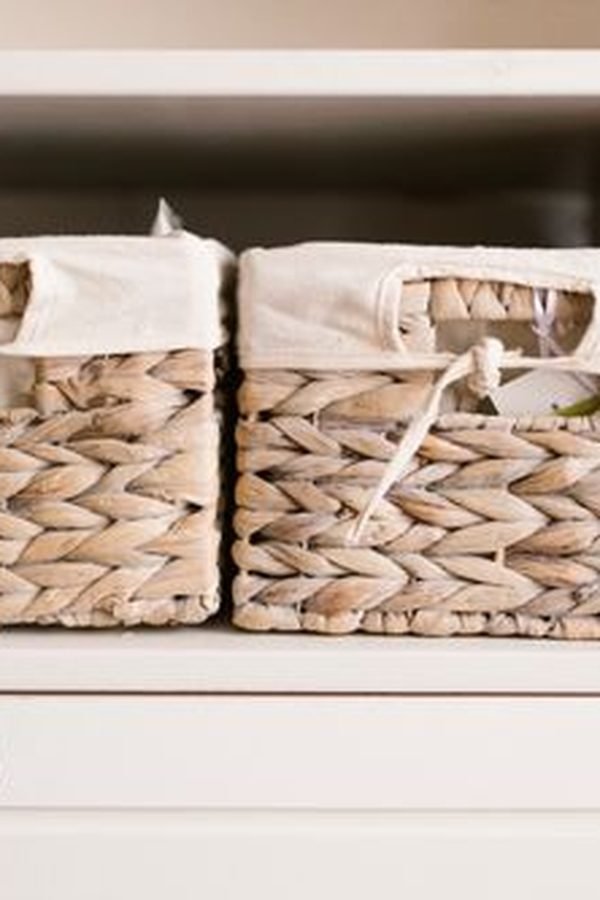
- Deep baskets or open bins — one per category. Deep bins are the workhorse. They fit back-to-front on standard shelves, pull out like drawers, and end the "lost item behind the cans" problem. Buy them after measuring, and prefer ones you can see through or at least see into.
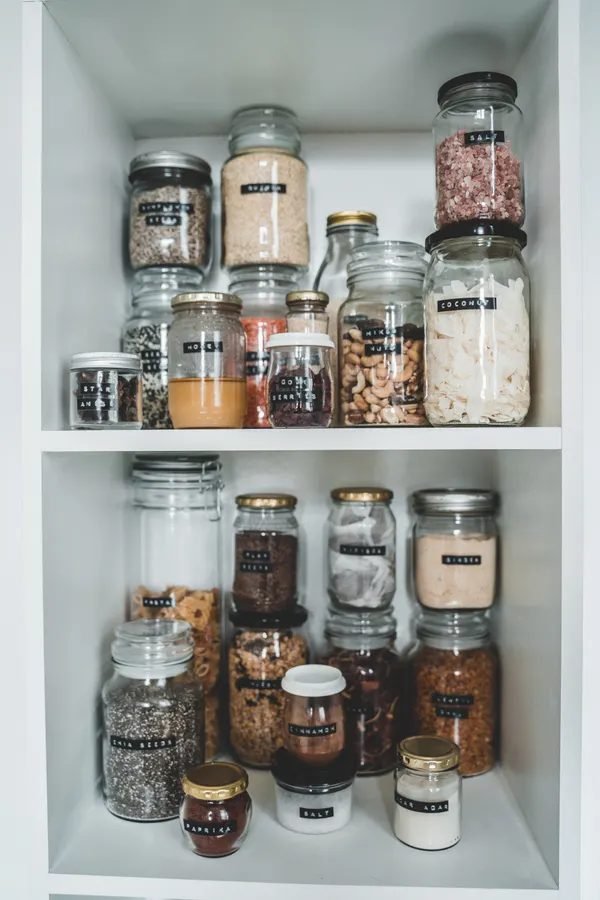
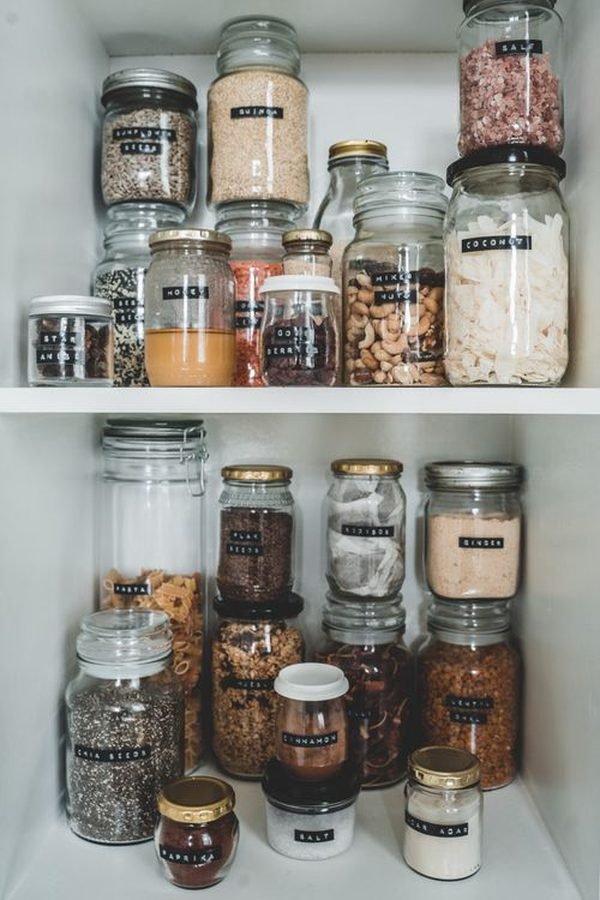
- A few clear jars for floppy-bag staples. Decant only the things that come in bags that slump, spill, or will not reseal: flour, sugar, rice, oats, cereal, pasta. Everything else can stay in its original box — decanting everything is a time sink, not a requirement.
- Shelf risers for canned goods. A $5–$10 wire riser turns one can shelf into two visible rows. Canned goods stacked directly on each other always hide the back row; risers fix that with no hardware.
- A lazy Susan for corners and tall shelves. Oils, vinegars, sauces, and condiments live on a turntable. One spin beats pulling five bottles forward to reach the one in back.
- Small trays for packet foods. Seasoning packets, tea bags, and sauce mixes vanish into dark corners. A small tray or a cutlery organizer keeps them corralled in one grab-able place.
- An over-the-door or door-mounted rack. If your pantry has a door, a $8–$12 rack adds a whole extra shelf of capacity for spices, packets, and small jars.
What to skip: matched sets of 24 canisters you will never fill (half of them will hold air), tall skinny bins for deep shelves (items slide behind them), and anything with a lid you need two hands to remove — in a real kitchen, annoying lids mean the bin quietly stops being used.
Zone Your Pantry: The Five Zones That Make It Stay Tidy
Zoning is the core of the system. Every item belongs to exactly one zone, and every zone has a fixed spot. Five zones cover almost every household:
- Everyday cooking. Oils, salt, pepper, the spices you reach for while the stove is on. This zone lives closest to the kitchen, at eye-to-waist level — never on the top shelf.
- Breakfast. Cereal, oats, coffee, tea, spreads, honey. One tray or bin keeps the morning rush to a single grab.
- Baking. Flour, sugar, baking powder, chocolate chips, extracts. If you bake weekly, keep it at arm level; if you bake twice a year, it can live up high or down low.
- Canned goods and jars. Soups, tomatoes, beans, broth. Line them in rows, oldest in front, on risers so every label stays visible.
- Snacks and grab items. Put kid snacks at kid height in a low bin — it ends the daily "where are the snacks?" excavation. Adult snacks go up a shelf.
Two placement rules keep the zones working. First: the most-used zones go at eye-to-waist level, the least-used up high or down low, no exceptions. Second: everyone in the house must know the zones. Tidiness is a team sport, and a system that only one person understands is a system that dies the week that person gets busy.
Small Pantries and Deep Shelves: Tricks That Actually Work
Deep shelves are the number-one pantry complaint — items slide to the back and get re-bought because nobody knew they were there. These fixes cost almost nothing:
- Row, don't stack. Line items front-to-back in rows like a grocery store, labels facing out. Nothing should hide behind anything taller than itself.
- Back = backup stock. Put the spare bag of flour and the extra jar of sauce in the back row, the open one in front. The back row becomes intentional storage instead of a graveyard.
- Use bins as pull-out drawers. A deep bin on a deep shelf pulls out like a drawer, giving you access to the full depth without reaching into the dark.
- Fill tall gaps with stackable shelves. Cans and short jars leave wasted air above them. A small wire shelf inside a tall shelf doubles the usable space for a few dollars.
- Add a door rack. Spices, packets, and small jars move to the door, freeing a full shelf of depth for the big stuff.
For genuinely tiny pantries — a single cabinet, a narrow closet — think vertically. Risers, stackable shelves, and door racks multiply a small footprint more than any container ever will.
Label Everything Without a Label Maker
Labels are the map of the system. Without them, groceries get put "wherever they fit," and the zones dissolve within a month. You do not need a label maker; these methods cost almost nothing:
- Painter's tape and a marker. Clean, readable, removable. Works on bins, jars, and shelf edges, and peels off without residue when a zone changes.
- Dollar-store chalkboard labels. Cheap, reusable, and easy to read at a glance.
- Label the shelf, not just the bin. Put a tape label on the shelf edge showing what lives there. When a bin is in the dishwasher or the snacks are gone, the empty spot still has a name — so it gets refilled correctly instead of being colonized by whatever arrives first.
Keep labels to one or two words: "Cans," "Baking," "Snacks," "Breakfast." A label should be readable from across the kitchen, not a sentence you have to walk up to.
The 10-Minute Weekly Reset
Even the best system drifts. The difference between a pantry that stays tidy and one that doesn't is a weekly reset that takes about ten minutes:
- Pull anything expired or stale to the front of one shelf. Check dates while you go.
- Toss what has to go and wipe the shelf. Crumbs and sticky jars are what make a pantry feel dirty even when it is organized.
- Push everything back to its zone, labels facing out. This is the whole reset — everything returns home.
- Restock the shopping list. Keep a small notepad on the inside of the pantry door: when something runs out during the week, write it there immediately. The reset turns it into the grocery list.
Ten minutes, same day each week, ideally right before grocery day. It is the cheapest maintenance habit in the house.
Final Thought
A tidy pantry on a budget is not about pretty containers — it is zones, one home per item, labels everyone can read, and a ten-minute weekly reset. Measure before you buy, zone by how you actually cook, and label the shelves as well as the bins. That system stays tidy for months, not days, and the whole thing costs less than one grocery run.