Small Kitchen Decor Ideas on a Budget: Style a Tiny Kitchen for Less
Some links in our guides may earn us a commission at no extra cost to you — here's why we only recommend what we'd buy.
Jump to a section
Small kitchens get a bad reputation they do not deserve. A tiny kitchen is cheaper to decorate than a big one — less paint, fewer cabinets, smaller everything — and small changes show up fast because there is nowhere for them to hide. These small kitchen decor ideas on a budget focus on the upgrades with the biggest visual payoff per dollar: editing what you own, refreshing hardware and paint, styling open shelves, fixing the lighting, and stealing vertical space. Most of them cost under $50, and several cost nothing at all.
First, Do the Free Fix: Clear and Edit
Before spending anything, take everything off the counters. Every small appliance, every utensil crock, every decorative sign — all of it onto the table. Now put back only what you use daily: the coffee maker if you brew every morning, the knife block, one cutting board. Everything else gets a proper home in a cabinet or leaves the kitchen. Counters are the walls of a small kitchen — cluttered counters read as a cluttered room, while clear counters instantly make the space feel larger. This single step, which costs nothing, does more for a tiny kitchen than any decor purchase.
Hearthly tip: the one-in-one-out rule keeps small kitchens small-kitchen-sized. Every new gadget that enters means one leaves — otherwise counters refill within a month.
The Cabinet Facelift: New Hardware, One Painted Surface
Cabinets dominate a small kitchen visually, so refreshing them pays off more here than anywhere else. Two cheap moves do the whole job.
Swap the Hardware
Swapping cabinet knobs and pulls is the highest-impact, lowest-effort upgrade in a small kitchen. Dated brass or plastic knobs drag down even decent cabinets; matte black, brushed nickel, or simple wood pulls make the same cabinets look current. A full kitchen usually needs 15 to 25 pieces, and multipacks bring the cost to around $1 to $2 per piece — roughly $30 total. Measure the hole spacing on existing pulls before ordering (the common sizes are 3 and 3.75 inches), and keep the old hardware in a labeled bag if you rent. One afternoon, one screwdriver, completely different kitchen.
Paint One Thing — or Peel-and-Stick the Backsplash
You do not need to paint every cabinet. In a small kitchen, painting just the lower cabinets in a deep, confident color — navy, forest green, charcoal — while leaving uppers white or cream creates a designer two-tone look with one quart of paint. Short on courage or renting? Peel-and-stick backsplash tiles have become genuinely convincing, cost $20 to $40 for a small kitchen, and install with scissors and a smoothing card in an afternoon. Either move draws the eye and makes builder-grade cabinets look intentional. If your upper cabinets have glass fronts, painting just the interiors a soft contrasting color is another cheap focal point.
Open Shelving That Looks Styled, Not Cluttered
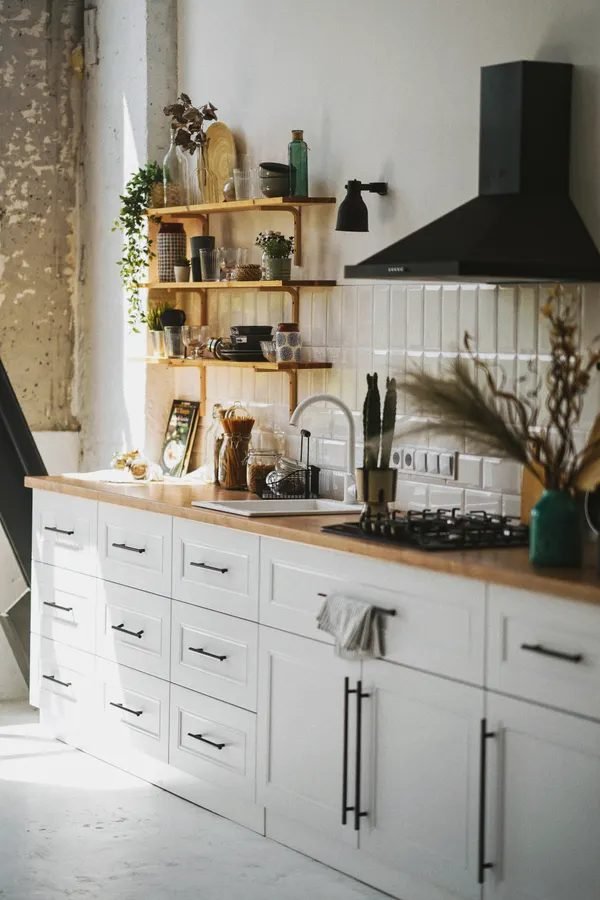
Removing one or two upper cabinet doors — or replacing them with a single open shelf — makes a small kitchen feel dramatically more open. But open shelves only work with rules, or they become clutter displays:
- Everyday dishes only. Shelves should hold what you actually use: stacked white bowls, glasses, mugs. If it is decorative-only, it is collecting grease.
- Repeat shapes and colors. Rows of similar items look calm; a jumble of random containers looks chaotic. Decant dry goods into matching jars for instant order.
- Leave breathing room. A shelf that is 70 percent full looks styled. A shelf that is 100 percent full looks like storage — because it is.
- One shelf is enough. You do not need to de-door the whole kitchen. One open section near the stove or sink gives the airy effect without the maintenance.
Light and Textiles: The Finishing Layer
Once cabinets and shelves are sorted, light and textiles are what make the kitchen feel finished rather than merely functional.
Fix the Lighting
Bad lighting hits small kitchens hardest, because there is no space for the eye to escape a harsh glare. The fix is cheap: battery-powered LED strip lights under the upper cabinets ($15 to $25) add task lighting exactly where you chop and read labels, with no wiring and no electrician. Swap the existing ceiling bulb for a warm-white one (2700K to 3000K) — cool "daylight" bulbs make small kitchens feel clinical. If there is space over the sink, a plug-in pendant on a cord cover adds a focal point for under $40. Warm, layered light makes even a galley kitchen feel welcoming instead of merely functional.
Textiles Make It Feel Finished
Textiles are the fastest way to add color and softness to a hard-surfaced room. A washable runner rug ($25 to $40) warms up cold tile and adds a stripe of pattern down a galley kitchen — choose low-pile and machine-washable, because kitchen floors take abuse. A simple cafe curtain on the window, hung on a tension rod with no drilling, softens the hardest-working window in the house. And matching dish towels, folded neatly over the oven handle or hung on a hook, read as intentional decor for about $10. These are small purchases, but they are what separate a "finished" kitchen from a merely functional one.
Steal Vertical Space for Storage
In a tiny kitchen, the walls and the insides of cabinet doors are free real estate. Put them to work:
- Hooks under upper cabinets hold mugs and free an entire shelf. Adhesive or screw-in, your choice — renters should use the adhesive kind rated for the weight.
- A magnetic knife strip on the wall or the side of a cabinet frees a drawer and keeps blades sharp longer than a crowded drawer does.
- A tension rod inside the cabinet under the sink creates a hanging rail for spray bottles, lifting them off the cabinet floor and doubling usable space.
- An over-the-door rack on the pantry door holds spices, wraps, and small items that otherwise colonize counters.
- A rail with S-hooks near the stove keeps daily utensils, a small plant, and a folded towel within reach and off the counter.
5 Small-Kitchen Mistakes That Waste Money
- Buying organizers before decluttering. Storage products for things you do not need are just expensive clutter. Edit first, then buy exactly what the survivors require.
- Dark paint in a windowless kitchen. Moody colors need light to work. In a kitchen with no window, keep walls light and add depth with lower cabinets or accessories instead.
- Themed decor sets. A matching set of rooster canisters dates a kitchen instantly. Individual pieces in a shared color palette look collected; sets look purchased.
- Ignoring the ceiling light. People refresh everything at eye level and leave a stained, yellowed ceiling fixture. A $25 flush-mount replacement takes twenty minutes.
- Too many small appliances on the counter. Each one costs counter space you cannot spare. Store the waffle maker; keep the daily coffee.
Final Thought
A small kitchen does not need more stuff — it needs fewer, better-chosen changes. Clear the counters, swap the hardware, warm the light, style one shelf, and steal the vertical space. Each move is cheap on its own; together they make a tiny kitchen feel intentional, brighter, and bigger than its square footage. Start with the free edit this weekend, and let the room tell you what it actually needs before you spend a dollar.